
There used to be a kind of rhythm to a good work day. Put on some music, open the files, get your hands into the work. At Cuberis, that meant museum websites – WordPress builds, content architecture, working within the specific constraints of cultural institutions with real budgets and real stakeholders. Satisfying work, the kind where you could step back at the end of the day and quantify your progress and completions.
That’s gone now, and I’m still sorting out how I feel about it.
What the Work Actually Looks Like Now
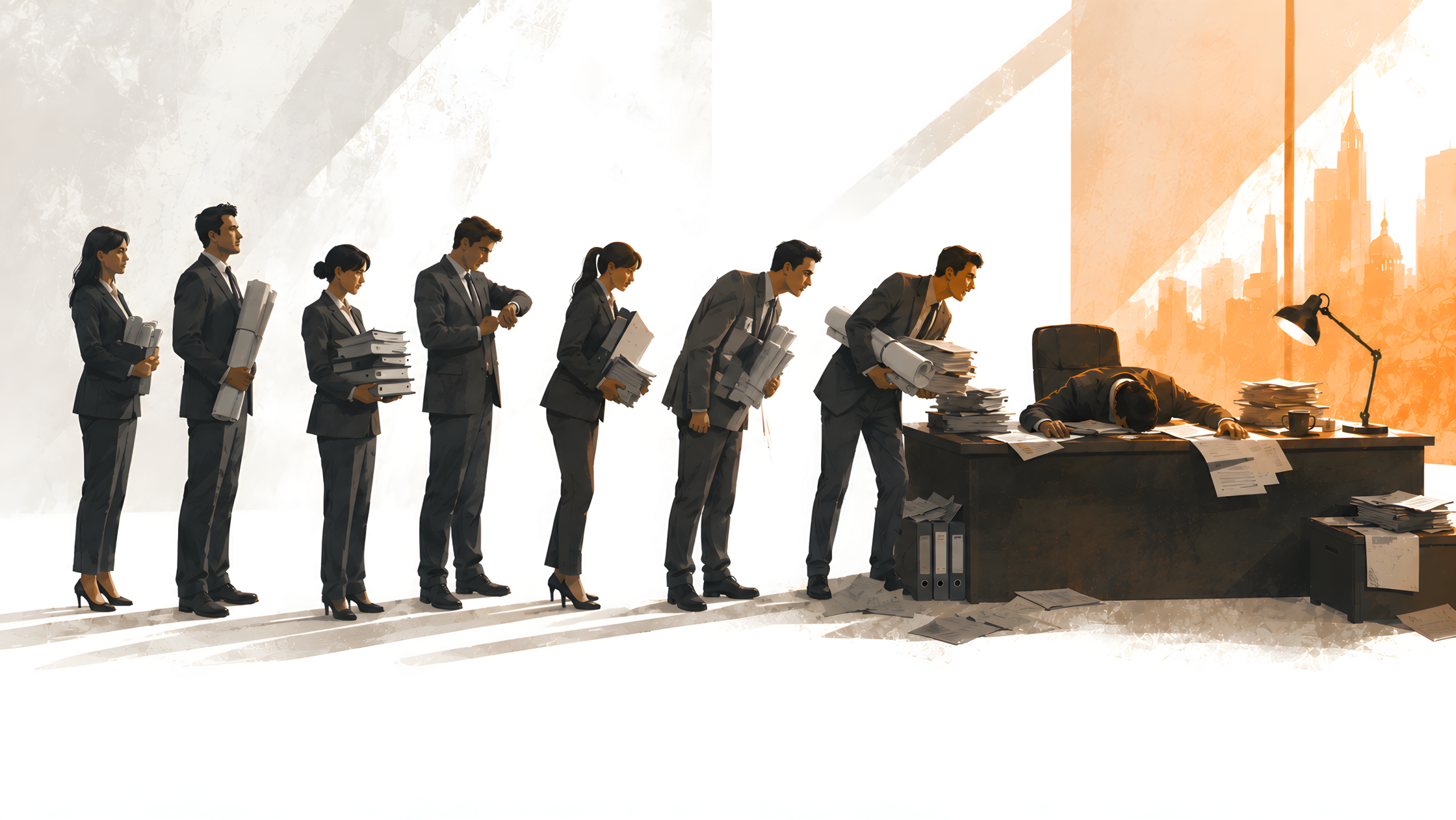
The closest description I can manage: imagine twelve senior engineers standing at your door. One at a time, they step in, show you what they built, look up, wait. You review it, redirect, approve, or send it back. You give the next instruction. They disappear. The next one steps up before you’ve finished exhaling.
That’s the day. That’s every day. The AI isn’t slow and it doesn’t need lunch. It just keeps coming. I’m a slave to the ding. I try to walk away to grab lunch but if the ding beckons I walk back to give whichever of the three or four sessions I have running another turn.
I’m building systems now – practical templates that my clients at small and mid-size agencies can pick up and use without having to go through what I’m going through to create them. And the output is astonishing. The kinds of things I can build in a week now would have taken months, or would have required budget and team beyond anything my clients would have. No, I take that back, I don’t think the degree of customization involved could have been built period. The systems are so nuanced that the effective market would be so small that the economics would make them utterly implausible. But today building custom tools for your specific workflows is no longer a pipe dream. That part is real, and I don’t want to undersell it.
But the cost of building them is not what I expected.
The Mental Load Nobody Talks About
I end most days brain-dead. Not tired in the old sense, where you’re physically worn out and feel like you accomplished something. This is different – it’s a specific, flat kind of depletion that comes from constant high-stakes decision-making at a pace the work never moved at before.
The old pace had natural breaks built in. Waiting on client feedback. Problems that needed a good nights sleep before giving them a fresh look. Those pauses weren’t inefficiency, I’ve come to understand. They were processing time. The work moved at a speed where judgment could keep up.
Now the raw attention and available judgment is the bottleneck, and AI is always faster than I am. It is always waiting on me. Every review I do, every redirect I give, every decision about whether what came back is what I’m after, or needs another pass, that’s on me, and there’s no slack in the line.
The tool can’t do the hard work of deciding what good looks like, or whether the system will hold up when a client’s team tries to use it, or whether the output is actually solving the right problem. That part doesn’t get automated. It just gets faster, which means more of it fits into the same day.
What I’m Actually Building Toward
Here’s the thing I keep coming back to when I’m fried at 6pm and my brain can barely put a sentence together: the person who will use what I’m building won’t have to go through this.
That matters to me. I spent years doing this with Newfangled – building processes and systems that could be handed off, that didn’t require the founder to be in every room for the thing to work. The grayscreen prototyping approach we developed came out of projects running three times over budget during the dot-com bust, because I had to fix the process itself since charging more was off the table in those days. Same instinct is driving this. But the process of innovation is not months, but minutes.
The agencies I work with don’t have six months to spend in the trenches figuring out where AI fits into a website build, or how to structure a review process so the output is actually usable, or how to make sure the experiments one person is running actually compound into something the whole firm can use. They have clients to serve and retainers to hold and people to pay. So I do that part, and I hand them systems that have already been beaten into shape, and train them how to then make them their own, fitted for their unique preferences and workflows.
That’s the trade I’ve made, and I think it’s worth it.
The Part I Miss
But I’ll be honest: I liked the old work. There was craft in it. The problem-solving had a physical quality to it, bringing ideas to life, implementing designs, the small satisfactions of a day that went well. I’m not sure what to call what I do now. It doesn’t feel like building in the same way. It feels more like directing, which is its own skill, but it’s a different one, and I’m still getting used to the fact that I didn’t exactly choose the trade.
The work chose it for me, the way the analog-to-digital transition in print production chose it for a lot of people in the early nineties. You either moved with it or you didn’t. I moved with it then. I’m moving with it now. But I’m allowed to notice what’s gone.
The Honest Version of What This Means for You
If you’re an agency owner looking at AI and wondering why it doesn’t feel as manageable or as exciting as the headlines suggest, it might be because the headlines are written by people who aren’t doing the actual building. The real skill isn’t prompting – it’s the sustained judgment work that happens around the prompting, the review, the decision-making, the knowing when it’s on target. That work is exhausting in a way that’s hard to describe until you’re in it.
But here’s what I’d tell you to hold onto: the exhaustion is not evidence that you’re doing it wrong. It might be evidence that you’re doing it right – that you’re in the work instead of generating output and calling it progress. The outputs I’m producing, and that I’m packaging for clients, are worth the cost. I believe that. Most mornings I still believe it pretty strongly, after I’ve given a long task to Fable so that my token usage will be back later in the morning.
The intensity doesn’t mean the direction is wrong. It just means we’re in the transition. Just got to give it time to adapt and learn new flows.