
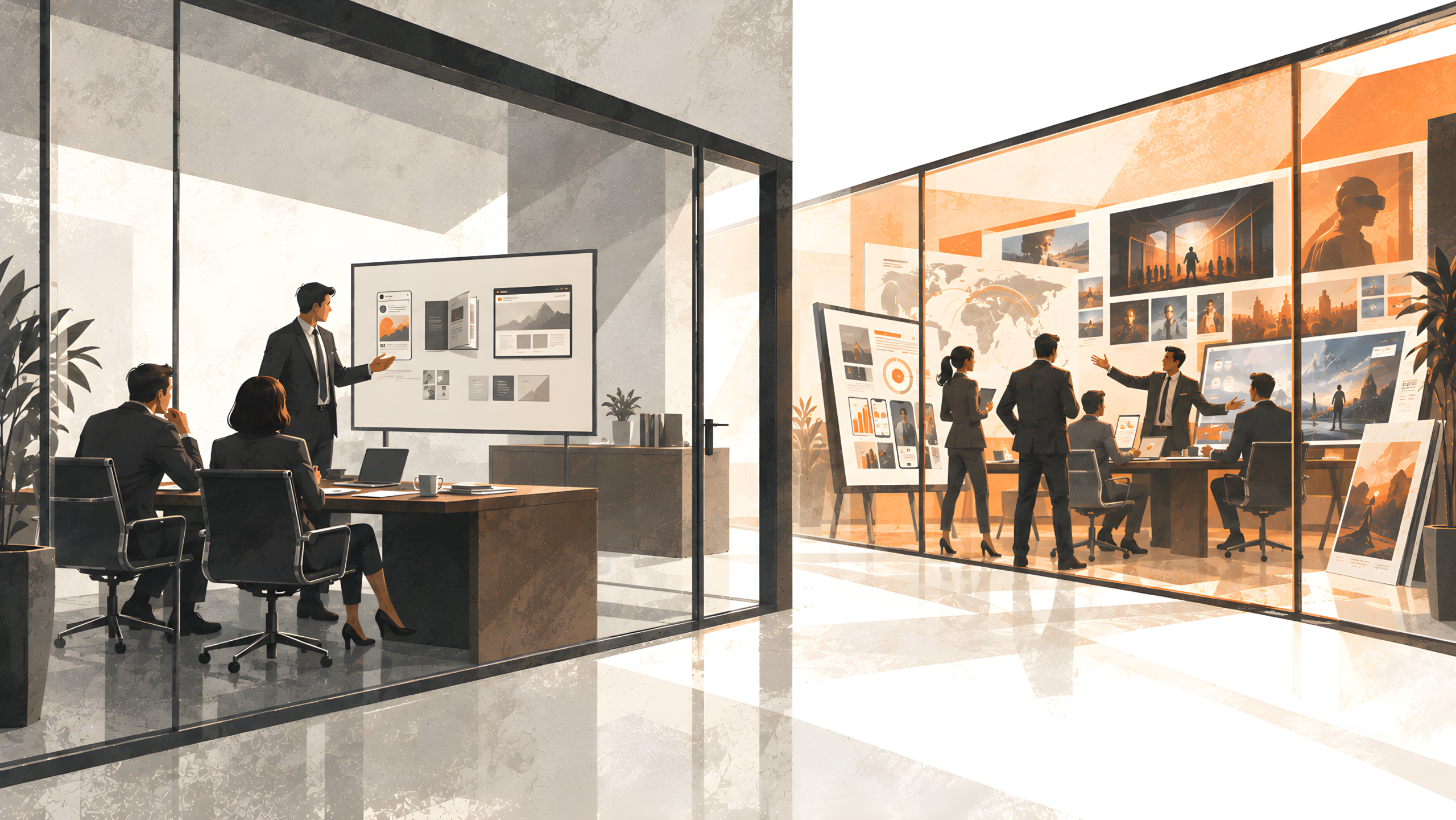
Most agencies are still focused primarily on how AI might replace the work they are already doing. Can ChatGPT write how I write? Can Claude Design create layouts like I design? Can Codex write code the way I used to pay developers to do? Those are the necessary starting point, of course. Getting good at that work has to be the first step. But they are all still questions about the work we were already doing.
There’s a third stage that most agencies haven’t reached yet, and it’s the exciting world we’re heading into.
Where most people are right now
Stage one is experimentation. This is where the majority of firms are now: moving past ChatGPT as an answer engine and starting to make things with Claude Code, Nano Banana, ChatGPT Images, or maybe even experimenting with some video models. Figuring out what these tools can do is the start. This stage is characterized by a lot of novelty and a lot of slop. That’s fine. That’s how you learn.
Stage two is production mastery. The novelty wears off. You get better at prompting, directing, refining, and combining tools to generate really good results. The slop disappears, or at least you get much better at recognizing and avoiding it. Work not only becomes faster and cheaper, but genuinely good, and honestly often better than what you were producing before. The real efficiency, productivity, and quality are staggering and still a little scary.
Most agencies are somewhere between stage one and stage two. Which is fine. But it’s not where things get really interesting.
What the third stage is
Stage three is possibility. It’s when you stop asking, “How can AI do what we already do?” and start asking, “What can we do now that we simply could not do before?”
That’s an exhilarating question. It doesn’t start with a current process and look for a place to insert AI. It starts with the ideas you shelved, the proposals you never wrote, the concepts you sketched and buried because the economics were so out of scale that even writing a proposal would be a fool’s errand. Interactive experiences only Disney could bankroll. Custom software for an audience of one. Personalized tools that might be the pet project of a billionaire but absurd for the common man. Complex data visualizations only experimental grad school labs would pursue. Digital products that required specialized teams, six-figure budgets, or expertise so far outside your wheelhouse that even quoting the project was irresponsible.
Those ideas may have been great. But they didn’t even make it into pitch decks, because they were so obviously economically absurd or technically impossible for a firm your size, or for clients with their budgets.
But many of them aren’t anymore.
The shift is real
Stage three removes constraints that shaped your creative imagination. And that’s disorienting, because we’ve spent years living with these constraints. We got good at scoping projects to what’s buildable. We learned how to talk clients out of the expensive versions of their dream solution. We internalized what’s feasible, and we stopped seeing the infeasible as anything other than a dead end.
Stage three requires unlearning some of that. It asks you to go back through your pile of dead ideas with fresh eyes, not as a creative exercise, but as an audit. What would you pitch tomorrow if you knew you could build it?
A custom calculator or configurator that used to require a development firm and weeks of sprints. A multimedia experience that would’ve needed a production company and a small movie production budget. An internal dashboard that gives a small nonprofit real-time insight into their audience without a six-figure CRM implementation.
These aren’t hypothetical. In one of my other companies, which builds websites for museums, we had a client a couple of years ago that wanted an animated, interactive experience with the historic founder of their institution. I had seen somewhat similar interactives on other museum websites, but something like that was way beyond this museum’s budget—probably ten times what they could even imagine spending.
A few years ago, that would’ve been the end of the conversation. It would’ve gone into the pile of ideas everyone loved but nobody could responsibly propose. But with these new tools, I was able to build a prototype that showed them the exact thing they’d always wanted, working right there in real time. They approved a modest proposal to build it out into a full user experience, and we’ll be deploying it in the coming weeks.
That’s what I mean by stage three. Not just doing familiar work faster, but making room for work that previously wouldn’t have made it out of the idea stage at all.
Why this changes the creative role
The work of creativity in stage one and two is still largely about execution: writing, designing, coding, producing. But in stage three, the most valuable thing a creative or an agency brings isn’t execution. It’s the ability to see what’s now possible and imagine how to deploy it for their clients.
That’s a different skill, and it’s one that advantages people who have been leaning into AI exploration, experimentation, and mastery. A person who’s spent twenty years listening to clients’ dreams, having moonshot ideas of their own, but then shaping those dreams into much smaller-scope plans that were actually doable—now those dream ideas may actually be plausible.
Stage three is when that library of dreams becomes buildable.
The path to stage three is messy
I don’t think there’s a clean process for getting to stage three. It goes beyond workflow changes and becomes more of a posture shift. But if you want to push yourself toward it, there’s a question that helps: what’s something your best client would be surprised and delighted by, that you have never been able to offer them because it was too expensive, too technically complex, or too far outside what an agency like yours could deliver?
Don’t answer it abstractly. Think about one specific client, one specific need, one idea that always felt out of reach.
Then go find out if it still is. That’s where the fun starts.