
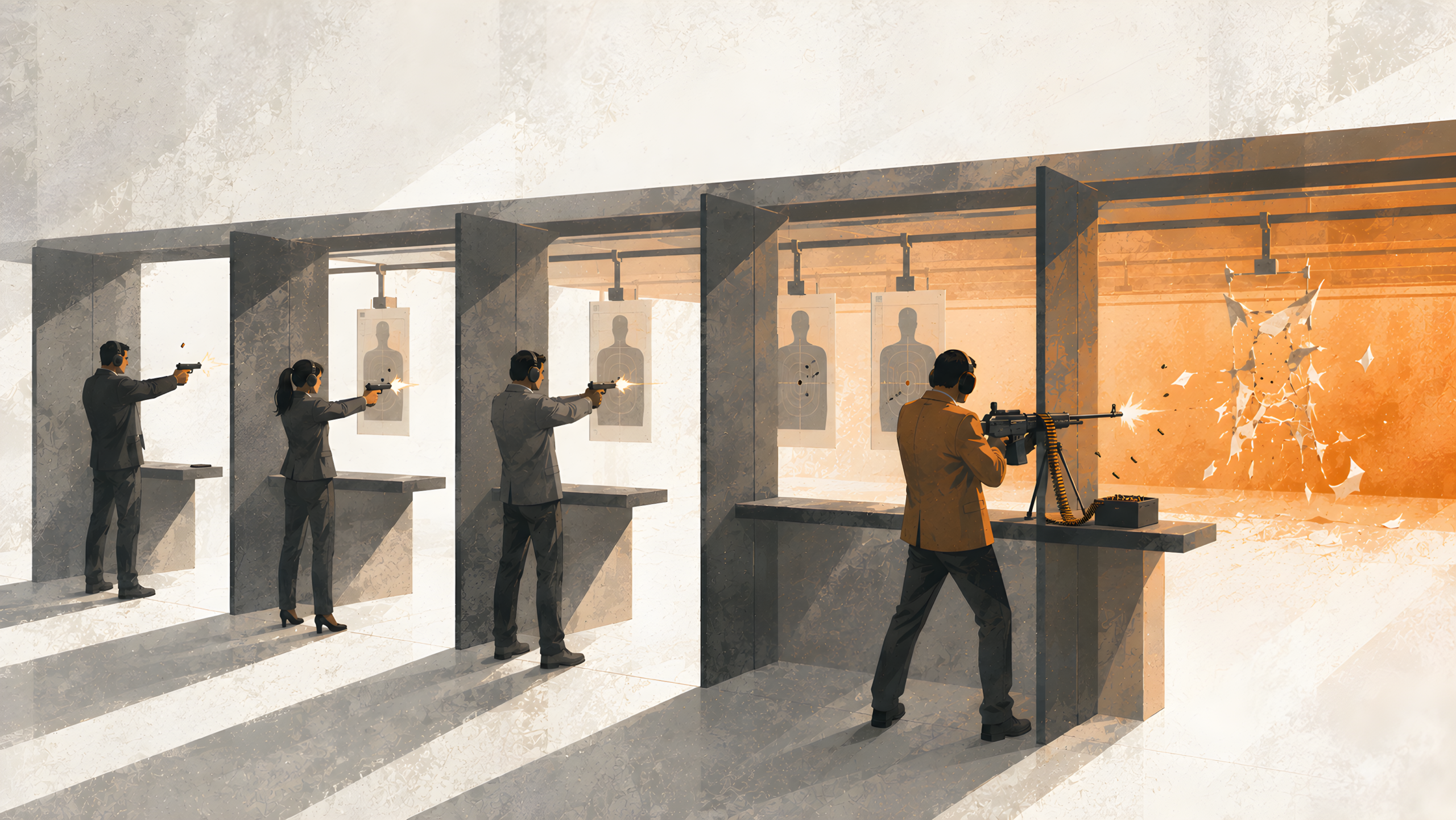
There’s an old argument in strategy circles that the best strategies aren’t designed in advance – they’re recognized after the fact. You look back at what you did, see what worked, and decide to do more of that. Blair Enns made a version of this point on a recent 2Bobs episode, and it’s been rattling around in my head ever since, because it maps almost onto something I’ve believed for a long time: Ready, Fire, Aim is not recklessness. It’s a different theory of how you learn what’s true.
Harry Beckwith put it in Selling the Invisible a few decades ago. Do enough thinking to get pointed in a reasonable direction. Execute. Let reality tell you something planning never could. Then adjust your aim and fire again. I think the reason this principle didn’t get more traction in agency work is that execution was expensive, and expensive execution punishes fast iteration.
AI just changed that.
What Made “Fire First” Risky
Think about what it actually cost to test an idea in a typical agency, even three years ago. Say you wanted to try a new content angle for a client’s nurture sequence, or prototype a new service offering, or run a quick positioning experiment on your own site. That meant writer time, designer time, maybe a developer if anything needed to be built, rounds of internal review, approval cycles, and a scheduling queue that pushed your “quick test” out three weeks.
When iteration costs a week of billable-adjacent work, you need to be pretty confident before you start. The cost of being wrong isn’t just the cost of that one attempt – it’s the opportunity cost of everything you didn’t do while you were building the thing that didn’t work. So agencies compensated by doing more strategy upfront. More discovery. More planning. More alignment meetings before anything got made.
That wasn’t irrational. It was the correct response to the economics of the time. But it had a hidden cost: most of that planning was based on assumptions, not outcomes, and assumptions are a poor substitute for actual market feedback.
What Changes When Execution Gets Cheap
A first draft that used to take a copywriter four hours might now take forty minutes, with AI doing the structural lift and the writer doing what they should have been doing the whole time – the editorial judgment, the voice calibration, the strategic call about what belongs in the piece. A prototype that once required a developer sprint can now be roughed out in an afternoon. A campaign angle that needed three internal reviews before anyone would even pitch it to the client can be mocked up and reacted to same day.
That’s not a marginal improvement. That’s a different relationship with iteration.
When the distance between idea and execution collapses, the cost of being wrong drops with it. And when the cost of being wrong drops, the math on strategy changes. You don’t need to invest as heavily in predicting reality – you can just interact with it faster. Think. Build. Deploy. Observe. Adjust. The cycle used to take weeks. Now it can take days, or hours, depending on what you’re testing.
The pricing implications of this are real, and most agency owners haven’t worked through them yet. But the strategic implications are just as substantial, and they’re getting less attention.
This Doesn’t Make Strategy Optional
I want to be careful here, because “fire first” gets misread as “don’t think.” That’s not the argument. You still need a direction. You still need a hypothesis worth testing. A random shot is not a strategy, and neither is shipping garbage quickly and calling it iteration.
What changes is the ratio. Before, you might spend 80% of your time on planning and 20% on execution and learning. The economics of expensive execution demanded that ratio. Now you can invert it – spend 20% getting oriented, 80% building and responding to what happens – and the quality of your strategy goes up, not down, because more of it is based on real data.
The agencies that are moving on this are treating AI not as a tool that makes the old workflow faster but as something that changes the structure of the workflow itself. That’s a meaningful distinction. Faster writing is a productivity gain. A shorter feedback loop is a strategic capability.
The second-order effect is that you can test things you would never have been willing to test before. Positioning experiments. New service offerings. New market segments. A quick sub-brand targeted at a vertical you’ve been curious about. None of those were realistic to prototype on a small agency’s bandwidth when each experiment cost weeks of work. The calculus on that has shifted, and the agencies figuring that out are getting a compounding advantage.
Where Agency Owners Get This Wrong
The failure mode I see most often is using AI to make the old process faster without questioning whether the old process made sense. Owners are cutting production time, but they’re still running the same approval loops, the same number of pre-execution alignment meetings, the same lengthy discovery phases for work that could be prototyped in a day. They’re saving time on execution and spending it all back on planning, which means the feedback loop never actually shortens.
The other failure mode is the opposite: shipping without any real evaluation. Moving fast with no mechanism for noticing what’s working is just noise. The “aim” in Ready, Fire, Aim is not optional – it’s the part where you develop actual strategic intelligence. If you’re not building in a real observation step, you’re not iterating, you’re just producing.
Workflow thinking – designing the sequence of inputs, outputs, review, and handoffs rather than just using AI on individual tasks – is what separates the agencies that are building genuine capability from the ones that are doing impressive demos and not much else.
The Economic Case
If you’re still unconvinced, think about it in terms of billable time and opportunity cost. A campaign concept that used to require a $4,000 investment in internal labor to develop well enough to present might now cost $500. If it works, great. If the client hates it and you need to pivot, you’re not eating a sunk-cost disaster – you’re eating an $500 lesson and building the next version.
That changes what you’re willing to try. And what you’re willing to try changes the ceiling on how good your work can get.
The agencies that understood this early in the AI wave are running positioning experiments, testing new services, and iterating on their own marketing at a pace that would have been impossible two years ago. They’re not smarter. They’re firing more, aiming better each time, and not flinching at the cost of being wrong.